aro Manjikian is a strongly built farmer with a degree in chemistry and a flourishing moustache like those in sepia photographs of Armenian gentlemen from the late Ottoman era. On the evening of 20 March last year, he was having dinner at George’s Restaurant in the woods where Syria’s Mediterranean shore adjoins Turkey’s. At his restaurant table, he told me, were five of his friends and their families. Their discussion turned to the conflict, entering its fourth year, to unseat Syrian president Bashar al-Assad. ‘The mayor of Kessab was with us. We asked him about the situation,’ Manjikian recalled. ‘He was very quiet.’
Kessab is the only Armenian town in Syria, although other Syrian villages and cities have Armenian minorities. Perched on a hillside within sight of the Turkish frontier, its 2,000-plus inhabitants also include about five hundred Alawite Muslims and Arab Christians. In the summer, tens of thousands of tourists used to fill its hotels and guest houses to bursting. The beaches, pine forests and fruit orchards hosted camps for Armenian Boy Scouts, as well as hikers, picnickers and Saudis seeking respite from stifling desert heat. In addition to the three churches for the Armenian Orthodox, Catholic and Protestant congregations, a large, modern mosque occupies a prominent position.
The conflict was killing tourism in Kessab. Incomes were down, hotels empty. Family visits to Aleppo, with its large Armenian population, became impossible after rebels occupied parts of the city in July 2012. Yet until now the conflict had left the region relatively unscathed. The greatest calamity to hit the town in 2013, apart from the decline in tourism, was not the war between al-Assad’s supporters and opponents but unseasonal hailstorms that destroyed the peach and apple crops.
However, events elsewhere in Syria were conspiring to engulf Kessab. On 16 March 2014, the Syrian Army with its Hezbollah allies expelled opposition forces from the town of Yabroud near the Lebanese border. This cut the opposition’s supply line from Lebanon and left the government dominant in most of western Syria. When the rebel leadership organised a response to threaten the regime’s coastal bastion of Latakia, their line of march led directly through Kessab.
Throughout March, one portent after another had made the Armenians of north-west Syria apprehensive. First, smugglers tipped off inhabitants that militant jihadists were gathering nearby in parts of south-west Turkey that had not seen them before. Then, Syrian farmers living beside the international frontier noticed gunmen mustering on the Turkish side.
By 18 March, regular Turkish Army units were disappearing from the forts guarding the twenty-five-mile border between Turkish Hatay and Syrian Kessab. Bearded paramilitaries in assorted non-Turkish uniforms were replacing them. A United Nations source confirmed what Manjikian told me. ‘Large numbers of fighters in minivans were going up the mountain. A Turkish Army convoy was coming down.’ The UN and the Syrian military received reports on 19 March that guerrillas in Turkey were moving dangerously close to Kessab. It seemed that the Turkish Army was relinquishing control of the border to ragged units of the Syrian opposition, although no one in Syria knew why.
On 20 March, while Garo Manjikian and Kessab’s Mayor Vazgen Chaparyan discussed politics over spicy sujuk sausages and Syrian wine, a fellow Armenian from Kessab telephoned the Syrian Army’s central command thirty miles to the south in Latakia. He relayed widespread fears of imminent rebel infiltration from Turkey. The commander dismissed the man’s worries on the grounds that an old agreement making the Turkish Army responsible for security north and east of Kessab was still in force. The Armenians were not reassured.
At four o’clock the next morning, 21 March, residents of the village of Gözlekçiler in Turkey observed paramilitary units driving through border checkpoints towards Kessab. They later told the Economist’s veteran Turkey correspondent, Amberin Zaman, that the Turkish military had evacuated civilians from Gözlekçiler and prohibited journalists from entering the area.
A half-hour later in Kessab, an artillery bombardment woke the Catholic pastor of St Michael the Archangel Church, Father Nareg Louisian. ‘The sounds became louder. The Turkish Army attacked our village,’ the 43-year-old priest told me. ‘Everybody felt it was a dangerous situation. We ran away. At the beginning, we thought it would be for some hours and it will finish.’
Residents of Sakhra, one of a dozen scattered hamlets and villages near Kessab, watched guerrilla fighters massing over the border in Turkey. They summoned Syrian border police. ‘The rebels shot at them at 5.30,’ a United Nations official said. ‘The Syrian border police shot back.’ Minutes later, assisted by mortar fire from Turkey, other rebels assaulted the Syrian police post at Qommeh. The battle for Kessab had begun.
Garo Manjikian woke as usual at 5.30 a.m. to start work in his family’s apple orchards between Kessab and Sakhra. ‘I heard voices from the Syrian police station,’ he told me when we met in Kessab six months later. ‘Then I heard guns. Then, after half an hour, explosions. Missiles. At 6.30, I saw with my eyes the Sakhra police station.’ By then, he recalled, it had become ‘a column of fire’. He woke his father and mother. As he struggled to move his mother, who was dying of cancer, the telephone rang. An Arab Christian woman from Sakhra begged Manjikian for help. She worked at Latakia’s university, where his children had studied. He drove to her house beside the border to rescue her, with her mother and son. Two mortars barely missed them, and he made it back home. Both families, including Manjikian’s three children, crammed into his light pickup truck. ‘There was not time to take my documents or my diploma,’ he said. A barrage of mortar fire hastened their departure. It was nine o’clock when they reached the village of Nab’ain, about five miles south. ‘When we saw the mortars hit Nab’ain, I knew this was going to be longer than we imagined.’ They fled again, this time all the way down to Latakia.
That evening, Syrian television broadcast the arrival of most of Kessab’s inhabitants at St Mary’s Armenian Orthodox Church in Latakia. Many of the two thousand men, women and children who fled Kessab crowded into the nave, the adjoining school and the church hall. Some had not had time to put on their day clothes, and most lacked basic provisions.
In Damascus, Armenian scholar Dr Nora Arissian watched her compatriots on television. ‘I saw them in their pyjamas,’ she said, ‘and it was 1915 again.’
No Armenian can forget 1915. From 24 April 1915, which Armenians commemorate as the beginning of a slaughter that in fact started earlier, the Ottoman Empire killed between 650,000 and 1.5 million Armenians in their homes, on death marches and in concentration camps. Some were murdered outright, while others died from starvation, disease, frost in the mountains or dehydration on the plain.
The genocide had historical roots. In the late nineteenth century, rebels in Bulgaria and Serbia, with Russian, British and French encouragement, massacred Muslims and caused the flight of hundreds of thousands of Muslim refugees to Turkish Anatolia. Turkish rulers, who had lost almost all their European lands in the Balkans, feared that leaving Christian, non-Turkish majorities in their eastern provinces would lead to further partition. That belief lay behind the removal of Armenians from areas where they predominated, while leaving small Armenian minorities elsewhere. Removal, however, meant murder. Talat Pasha, one of the triumvirate of Young Turks who ruled the empire from behind the sultan’s
throne during the First World War, told a German consul in June 1915: ‘What we are dealing with here . . . is the annihilation of the Armenians.’
When Turkey joined the German war against the Allies, in 1914, its leaders had dreams of expanding the empire through Russian territory to include the Turkish-speaking regions of Central Asia. Their attempt to invade the Russian Empire collapsed in January 1915, when the Russians smashed the advancing Turkish Third Army at Sarikamish in the mountains of eastern Turkey. Between 60,000 and 90,000 Ottoman soldiers died in battle or froze to death. Turkey’s leaders blamed Armenians as the ostensible ‘enemy within’, although Armenian soldiers lay among the Ottoman dead. From then on, the Armenians were doomed. Armenian men between the ages of twenty and forty-five, all of whom had been conscripted into the army, were disarmed. Commanders forced them into labour battalions, digging trenches, paving roads and cutting trees. Those who did not die of overwork, disease and starvation were taken out in small groups and executed. Armenian women, children and elderly men were left without protectors. The Turks gave some of them a few days to sell their property, at a fraction of its value, and to pack their clothes. Others were driven from their houses in their pyjamas with no time to gather any possessions. Turkish police and troops deported the defenceless civilians on what were in effect death marches to the desert in Syria. En route to Deir Ezzor, more than two hundred miles through the desert from Aleppo, they were robbed, raped, kidnapped, starved and tortured.
The remnant who made it to the concentration camps were enslaved, butchered or burned to death. A few brave Turkish, Kurdish and Arab civilians provided refuge to Armenians, sometimes adopting the children in order to save them. Thousands of Armenian women were forced into marriage with Muslim men, while others suffered rape by soldiers or tribesmen.
Following the armistice between Turkey and the Allies on 30 October 1918, the killing stopped, leaving traumatised survivors, along with the Armenians of Istanbul and a few other large cities who were not deported. Some tried to go back to Turkish Armenia, but the Turks drove them out. A few hundred remained in the village of Vakifli on the Turkish side of the border north of Kessab, but most emigrated to the Americas or settled in Lebanon and Syria. A country called Armenia, the eastern portion of the ancient nation that had little connection to western Armenia of the Ottomans, rose out of the war as a socialist republic of the Soviet Union. Like Syria and Lebanon, it gave shelter to refugees from Turkey.
Many Turks and Kurds today have Armenian grandmothers, a fact some deny and others have come to embrace. One day, a Kurdish waiter at a riverside restaurant outside Damascus interrupted my conversation with Missak Baghboudarian, the musical director and chief conductor of Syria’s National Symphony Orchestra, to ask Missak whether he was Armenian. When Missak responded in the affirmative, the waiter said that his grandmother was Armenian. He looked proud of the fact. When the waiter left, Missak compared the Kurds, who participated in the genocide, to the Turks: ‘The Kurds admit they made a mistake. That is the difference.’
Dr Arissian is a young history professor at Damascus University whose gentle voice belies her determination to bring attention to the Armenian tragedy. I met with her during my visit to Syria in autumn 2014. ‘The Syrian press was the first to use the word “genocide” about the Armenians, in 1917,’ she told me over espresso at Il Caffè di Roma in Kassa’a, a Christian neighbourhood near Damascus’s ancient walled city. She discovered during her research that Syrian Arabic newspapers like Al Asima, Alef Baa and Al Muktabas reported on the mass deportations of Armenians as they took place. Despite Ottoman censorship, the papers published stories with the terms ‘extermination’, ‘annihilation’, ‘uprooting the race’. The Arabic word for genocide, she said, was ibada, which appeared often in the Syrian press during the First World War.
The immediacy with which Dr Arissian spoke of Armenian genocide was new. Most of the Armenians who spoke to me in Damascus before I drove up to Kessab last autumn talked about genocide, past and possibly future, when in years past their conversation had been about food, drink, love affairs and Mid-East politics. Something changed in March 2014 to make the only topic of conversation genocide, and fear of genocide.
Despite their apprehensions, most of them had no desire to leave Syria. Dr Arissian said, ‘The Armenian genocide made the Armenians in Syria grateful to Syria.’ In Syria, they had built churches, schools, social clubs, sports centres and businesses. There were no restrictions on speaking or publishing in Armenian. Armenians constituted a separate, respected community, whose honesty and industry were acknowledged by Syria’s Arabs and Kurds. ‘In Aleppo, any Arab who wants to repair his watch or his shoes goes to an Armenian,’ she said. ‘They know the Armenians are straight. You never find an Armenian thief.’ True or not, this is the popular perception in Syria among Armenians and non-Armenians alike.
‘Once, I did not do my homework,’ Missak Baghboudarian recalled of his Damascus childhood. ‘My teacher told me that, until now, we Armenians have a good reputation. You must keep that reputation.’ Armenian leaders in the refugee shanty towns of the 1920s forbade criminal activity and prostitution that would shame their community. Memories of rape and forced marriages were strong. The refugees had neither property nor money, but they worked hard to create businesses and move out of the camps. In Damascus and Aleppo, they joined a middle-class community of Armenians who had lived in Syria since at least the sixteenth century. The communities melded and ensured their survival by staying out of politics.
Their acceptance in Syrian society became evident when the people of Kessab fled to Latakia in 2014. One Kessab Armenian told me, ‘We must be proud to be Syrian, because all the ethnic mosaic of Latakia – the Alawis, the Sunnis and the Christians – helped us.’ Dr Arissian believed that the war was bringing Armenians closer to their fellow Syrians. ‘Before the war, I said we are not integrated in the Syrian community. But I was wrong.’
The temptation to emigrate, however, had always been strong, due to decades of instability, tyranny and intermittent threats from Islamic exclusivists seeking a pure Sunni Muslim Syria. In 1960, there were about 150,000 Armenians in Syria. The numbers steadily declined to 115,000 in 1996. Last August, Bishop Armash Nalbandian, the primate of the Armenian Orthodox Church in Damascus, told me that about 30,000 Syrian Armenians had left since the war began. ‘Nobody has sold his property or his house,’ he added. ‘They are waiting to come back.’ This may be optimistic, but Armenians who remain in Syria fear the fate of their more numerous brethren in Paris and Los Angeles: assimilation into Western culture leading to loss of language and faith. It is within Islamic Syria, paradoxically, that they feel most Armenian. ‘We like Armenia,’ Kessab farmer Garo Manjikian said, ‘but we love Syria. This is my country. We can keep our originality here. We can keep our identity in this Muslim environment more than in the West.’ Bishop Nalbandian, speaking in his office next to the Armenian school in Damascus, echoed Manjikian. ‘We witnessed a new kind of Islam. We were persecuted in Turkey, because we were not Muslim. My grandparents came as refugees. We were welcomed.’
An Armenian house decorator named Samir Mikho told me over coffee in his modest flat in Dweila, a mixed Damascus neighbourhood of Muslims, Christian Arabs and Armenians, that Syria would always be his home. ‘A century ago, my parents left their country,’ he said. ‘Their church became a stable. We don’t want that to happen here.’ Mikho’s resolve to stay was unexpected in light of the fact that, a year earlier, a mortar shell hit the Armenian school’s bus stop and killed his ten-year-old daughter, Vanessa.
This year, Armenians mark the centenary of the massacres. It may have been no more than a coincidence that German officers, whose empire was allied to the Ottomans, participated in some of the bloodletting. During the First World War, the Allies declared Turkey’s deeds ‘crimes against humanity’, originating a term they would later apply to Nazi actions. British Prime Minister David Lloyd George called what befell the Armenians then a ‘holocaust’. After 1945, Germany recognised its guilt and made some restitution. Turkey never did.
Now a new generation of Turkish historians, notably Taner Akçam in his epic A Shameful Act: The Armenian Genocide and the Question of Turkish Responsibility, has taken the risk of using the word, with its implications of moral culpability and the obligation to redress wrongs. The expulsions and murders of the Ottoman Empire’s Armenian subjects continued until Turkey lost the war and the Allies occupied Istanbul. It resumed for a time under the nationalist government of Mustafa Kemal Atatürk. Atatürk himself later conceded that it was ‘a shameful act’, subsequently the title of Akçam’s powerful book.
To this day, however, Turkey’s official position is that the Armenians brought disaster on themselves by supporting the empire’s enemies. The government has forbidden its citizens to utter the word ‘genocide’: Article 301 of the Turkish Penal Code makes it an offence to ‘insult Turkishness’, and those convicted can be sentenced to ten years in prison. Armenian writer Hrant Dink, who was assassinated in 2011, novelist Elif Shafak and Nobel Laureate Orhan Pamuk have all been prosecuted under Article 301.
Turkey’s continuing denial made Armenians around the world particularly sensitive to the occupation of Kessab in 2014. It was as if modern Germany, while refusing to acknowledge its genocide of Jews, had unleashed bands of neo-Nazi skinheads on a Jewish town over the border with Holland. As Dutch Jews would discern a German hand in their victimisation, Armenians understandably saw Turkey’s. Moreover, Kessab was a last corner of the medieval Armenian Kingdom of Cilicia that fell in 1375. The oldest Armenian church in the region, St Stephen’s, built in the tenth century, is located there. Turkey had ethnically cleansed Kessab twice, during the pogroms of 1909, when it also killed 30,000 Armenians in Adana, and in 1915. Both times, the people returned and rebuilt. Thus the attack on Kessab resonated more with the Armenian diaspora than the rebel attacks on Armenian quarters in other Syrian towns.
The 2014 conquest of Kessab was not a repetition of 1915. There was no massacre, possibly because most of the inhabitants fled. The first casualty was 24-year-old Gevorg Juryan, whom, Catholic Father Louisian conceded, rebels might have mistaken for a soldier because he wore military-style boots. ‘They left his body in front of his house,’ he said. ‘The family begged to be allowed to bury him, but they allowed it only after three days.’ Fighting between army and rebels killed another Armenian civilian, but two deaths do not constitute genocide. The jihadists spared twenty or so aged villagers who were too infirm to escape. They were escorted to the border, and the Turkish Army drove them to the Armenian village in Turkey, Vakifli, about twenty-five miles north. Syria, which by then had suffered more than 150,000 deaths in its increasingly savage war, had witnessed far worse.
Yet the jihadists called their offensive in Kessab al-Anfal, ‘the spoils’, from a chapter in the Quran:
And know that whatever ye take as spoils of war, lo! a fifth thereof is for Allah, and for the messenger and for the kinsman (who hath need) and orphans and the needy and the wayfarer, if ye believe in Allah . . .
Al-Anfal was a provocative term. The last military campaign to take the name al-Anfal was Saddam Hussein’s 1988 slaughter of more than 100,000 Kurds in northern Iraq, belatedly condemned around the world as genocide. In 1915, the Ottoman state distributed the spoils seized from deported Armenians – land, houses, furniture, books, jewellery and clothing – to its Muslim subjects. In Kessab in 2014, similarly, the jihadists looted houses, churches, hotels and shops, trucking much of the booty to Turkey.
A minority of the rebels were from the American-supported Syrian National Coalition, but most belonged to Sunni fundamentalist factions, like the Islamic Front, Ansar ash-Sham and al-Qaeda’s official wing in Syria, the Nusra Front. They transformed Kessab into a barracks, commandeering abandoned houses and hotels. They posted their destruction of church crucifixes on social media, but did little other damage in the first week.
A day later, rebels moved south to the region’s highest summit, Observatory 45, where a television transmission tower overlooked most of Latakia Province. The hilltops changed hands several times, as the opposition and the Syrian Army fought bitter battles for the high ground. On 23 March, a Turkish warplane downed a Syrian jet attempting to bomb the Nusra Front rebels near Kessab, and Turkish Prime Minister Recep Tayyip Erdoğan praised the pilot. Meanwhile, opposition artillery exploded near the Armenians’ refuge inside St Mary’s Church in Latakia. They felt they had nowhere to hide from forces they viewed as nothing more than Turkey’s mercenaries.
By the end of March 2014, rebels with Turkish air cover and artillery support controlled most of the Kessab region. On 1 April, the head of the Syrian National Coalition, Ahmad Asi Al-Jarba, came to Observatory 45 to be photographed with his men and their Islamist allies. Other rebels posted video pictures of themselves in the sea below George’s Restaurant, where Garo Manjikian and Mayor Vazgen Chaparyan had dined the night before they fled. There were now two wars: one for territory, the other for public opinion.
Rival propaganda machines manufactured evidence for the Internet, television and the press. Accounts by jihadists, the Turkish government and media on the one hand and the Syrian government and media and overseas Armenian lobbies on the other conflicted in every detail. It became almost impossible, especially with no journalists able to enter Kessab without risking rebel kidnapping, to sift truth from fiction.
The Turkish press peddled an image of benevolent jihadists in Kessab. One article stated that two octogenarian sisters, Sirpuhi and Satenik Titizyan, were grateful to the fundamentalists for rescuing them and bringing them to ‘paradise’ in Turkey. However, in a subsequent interview with Istanbul’s Armenian newspaper, Agos, the sisters said, ‘The bearded men came to our home. They spoke Turkish. They rifled through our belongings and asked if we had guns.’ The paper added, ‘The two women reported that they were deported to the Turkish border, even though they told the men that they wanted to leave for the Syrian port city of Latakia.’
One Armenian paper, Asbarez of Los Angeles, claimed that Turks and rebels had murdered eighty Armenians in Kessab. Other overseas Armenians disseminated reports of mass killings and posted photos and videos that included the bloody corpse of a woman with a crucifix rammed into her mouth. It later transpired that the photo was from Inner Depravity, a 2005 Canadian horror film.
Armenians worldwide mobilised behind the #SaveKessab social-media campaign. Armenian-American television celebrity Kim Kardashian, whose public persona would previously have offended Syria’s conservative Armenians, tweeted: ‘Please let’s not let history repeat itself!!!!!! Let’s get this trending!!!! #SaveKessab #ArmenianGenocide.’ Mayor Chaparyan tried to set the record straight, declaring, ‘Armenians [have not been] killed. I do not know where these rumours are being created.’
Nonetheless, the Armenian disinformation campaign was having an effect. Four members of the US Congress wrote to President Barack Obama on 28 March: ‘With the Christian Armenian community being uprooted from its homeland, yet again, we strongly urge you to take all necessary measures without delay to safeguard the Christian Armenian community of Kessab.’ On 2 April, California Congressman Adam Schiff questioned American UN Ambassador Samantha Power, a vocal supporter of anti-Assad rebels, about Kessab’s Armenians. Schiff stated that ‘there is a particular poignancy to their being targeted in this manner’. One week later, six members of Congress denounced Turkey at a news conference in Washington. The Armenian National Committee urged the president and Congress to compel Turkey to cease its support for another genocide of Armenians. An online petition demanded that the US stop ‘history repeating itself’. Despite the Armenian lobby’s exaggerations and distortions, the onslaught was forcing Turkey to weigh its patronage of the rebels in Kessab against the harm to its relationship with the West.
On Tuesday, 3 June, Turkey for the first time branded the Nusra Front that had led the assault on Kessab a ‘terrorist organisation’. Turkish support for al-Nusra and its allies gradually dried up in the Kessab region, easing the way for a Syrian Army offensive. Although Turkey continued to allow jihadists to enter Syria along the rest of the five-hundred-mile border, Kessab became a no-go area for the jihadis. Syrian government forces took the town on 15 June, ending a three-month occupation. The people began returning the next day.
Garo Manjikian told me that he returned within hours of Kessab’s liberation. He reopened his grocery store, but his tractors and other farm equipment had been stolen. He and some friends founded the Syrian Armenian Committee for Urgent Relief and Rehabilitation of Kessab to oversee reconstruction. Strangely, I did not see Syrian soldiers in the town. Apart from a few checkpoints on the roads outside, there was no military presence to defend the area from a second rebel invasion. And there was little if any fear of it. ‘The Turks will not do the same thing again,’ Manjikian said with confidence, placing his trust in the Armenian lobby in the US.
Although the rebels damaged the town, they did not destroy it. Most buildings were intact, but windows were smashed, doors removed and furniture looted. The rebels were not alone in the pillaging – one house that I visited had been looted by ‘liberators’ from the Syrian Army. The jihadist occupiers took a special interest in pianos, destroying every single one. The Armenian Cultural Centre’s music school had been teaching piano to twenty-seven students. The Cultural Centre had been burned, along with its books and pictures.
The pastors of the three Christian denominations took me on a tour of their churches. They were pleased that so many members of their respective flocks had returned, although about 20 per cent stayed in Latakia or left Syria. ‘We cannot stop people emigrating,’ Pastor Sevag Trashian said, ‘but the majority of our community wants to stay here. We want to return Kessab to its good days. We have our own contribution as Christians and as Armenians to this mosaic.’
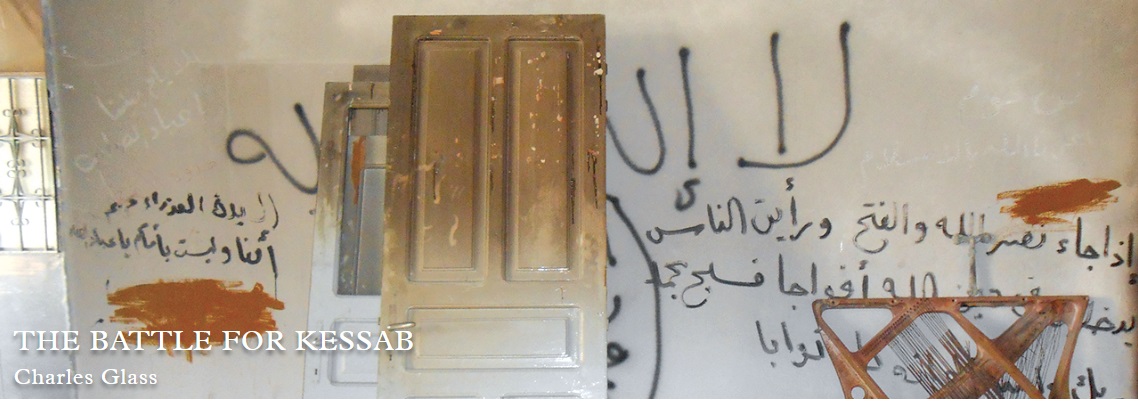
The three clerics showed me the damage to their churches, the desecration, the burned books, the slashed paintings. Artisans labouring to restore the church buildings had yet to remove the jihadists’ Arabic graffiti:
Soldiers of the Only One were here. God willing, we will crush the Christians, Armenians and Alawis.
We will go after you wherever you go, God willing.
Do not rejoice, Christians. We will step on you.
It is a matter of time before we get you, worshippers of the cross.
In Deir Ezzor, where a century ago thousands of Armenians had been herded into camps, starved and killed, jihadis blew up the Armenian Genocide Memorial Church. They then scattered the bones of the victims who perished between 1915 and 1918.
The first time I visited Kessab was in 1987. My friend Armen Mazloumian, whose grandfather founded the famous Baron’s Hotel in Aleppo, escorted me to the Evangelical Protestant church. It was as austere as any Presbyterian kirk in Scotland, devoid of Eastern Christianity’s icons, incense and statues. The only decoration was a childlike painting that I described at the time:
It showed Jesus Christ, the Good Shepherd, holding in His arms the body of a slain boy, the boy’s head and arms dangling like Christ’s own in Michelangelo’s Pietà. Behind Him were the mountains of Armenia, and at His feet was a mound of skulls and bones with the date ‘1915’ written on them. The caption was in Armenian, which Armen translated: ‘So much blood. Let our grandchildren forgive you.’
The painting, like everything else in all of Kessab’s churches, had been burned.
Image courtesy of the author. ‘It is a matter of time before we get you, worshippers of the cross.’ Graffiti on church building, Kessab, 2014
Published in